
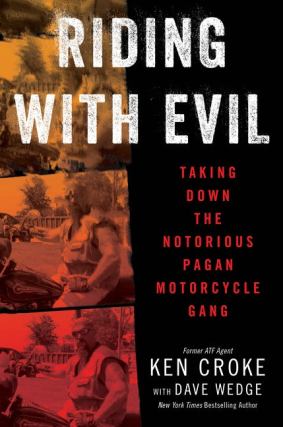
 Former federal law enforcement agent Ken Croke tells the story of the two years he spent undercover infiltrating the infamous Pagan Motorcycle Club, a white supremacist biker gang, in the new book Riding with Evil: Taking Down the Notorious Pagan Motorcycle Gang (William Morrow/Harper Collins, 2022). Written with bestselling writer Dave Wedge, a Boston College alumnus, Riding with Evil delivers a nail-biting account of the secretive and brutal biker underworld—the unspeakable violence, extremism, drugs, and disgusting rituals. At great personal risk, Croke built a case that would eventually bring down the top members of the gang in a large-scale federal prosecution. Wedge’s other publications include Hunting Whitey: The Inside Story of the Capture & Killing of America’s Most Wanted Crime Boss; The Last Days of John Lennon; and Boston Strong: A City’s Triumph over Tragedy.
Undercover in the underworld
Helping companies create social value
 To address the problems facing society, companies must shift their corporate mindset from sustainability (do no harm) to creating social value (do more good), according to leadership and social innovation experts Philip Mirvis and Bradley K. Googins, authors of the new book Sustainability to Social Change: Lead Your Company from Managing Risks to Creating Social Value (Kogan Page, 2022). Their book outlines the strategies and practices that leaders can use to address the five biggest problems facing companies and society today: purpose, prosperity, products, planet and people. Filled with real life examples, hands-on guidelines, and self-assessments to rate your company’s performance, Sustainability to Social Change can help business leaders pivot their company’s mindset and practices in order to enhance society and the environment, and fuel their own success. Bradley Googins is a retired Boston College professor who served as executive director BC’s Center for Corporate Citizenship.
Undoing the knots of racism
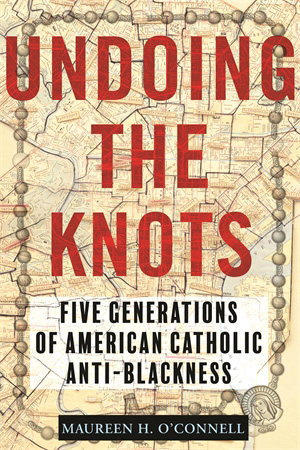 Theologian Maureen O’Connell has written a personal and historical examination of white Catholic anti-Blackness in the U.S. and a call for meaningful racial healing and justice within Catholicism. In Undoing The Knots: Five Generations of American Catholic Anti-Blackness (Beacon Press, 2022), O’Connell excavates her Catholic family’s entanglements with race and racism from the time they immigrated to America to the present, and traces, by implication, why, despite the tenets of their faith, so many white Catholics have lukewarm commitments to racial justice. O’Connell, who earned a Ph.D. in theological ethics from BC’s Theology Department, is an associate professor of Christian ethics at La Salle University. She is also author of Compassion: Loving Our Neighbor in an Age of Globalization and the award-winning If These Walls Could Talk: Community Muralism and the Beauty of Justice. Emma McDonald, a doctoral candidate in theological ethics at Boston College, penned a review of Undoing the Knots for Commonweal magazine.
The theology of pilgrimages
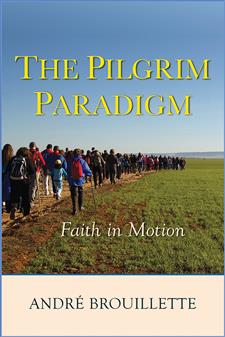 It is not surprising that pilgrimages attract broad interest from travelers, dreamers, and readers. Despite the enduring popularity of pilgrimages, Christian theology has not fully engaged this reality. In his new book, The Pilgrim Paradigm: Faith in Motion (Paulist Press, 2022), BC School of Theology and Ministry Associate Professor of Systematic and Spiritual Theology André Brouillette, S.J., explores the richness of the pilgrimage—its significance theologically, intellectually, and practically. This academic year, Fr. Brouillette served as the Anna and Donald Waite Endowed Chair in Jesuit Education at Creighton University.
Posted in Boston College Authors
Tagged Jesuit author, pilgrimage, School of Theology and Ministry
Leave a comment
Remembering the 1918 influenza pandemic
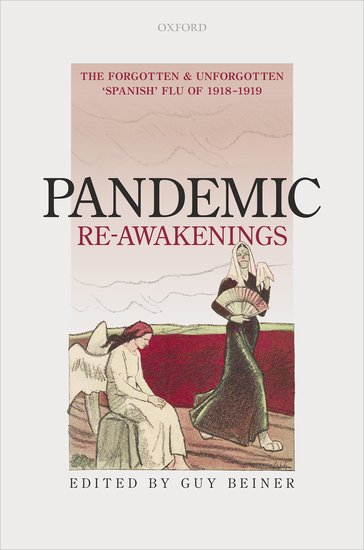 A new book, edited by Sullivan Professor of Irish Studies Guy Beiner, explores a century of remembering, forgetting, and rediscovering the influenza pandemic of 1918-1919. In Pandemic Re-Awakenings: The Forgotten and Unforgotten ‘Spanish’ Flu of 1918-1919 (Oxford University Press, 2021), more than 20 scholars offer original essays from the perspectives of personal, communal, medical, and cultural histories in different national and transnational settings. The volume reveals how, even though the Great Flu was overshadowed by the commemorative culture of the Great War, recollections of the pandemic persisted over time to re-emerge towards the centenary of the ‘Spanish’ Flu and burst into public consciousness following the outbreak of the COVID-19 pandemic. Beiner studies history, memory, and social forgetting and is the author of the award-winning publication, Forgetful Remembrance: Social Forgetting and Vernacular Historiography of a Rebellion in Ulster.
The power of right-wing comedy
 In their new book, That’s Not Funny: How the Right Makes Comedy Work for Them (University of California Press, 2022), authors Matt Sienkiewicz and Nick Marx argue that it is both an intellectual and politically strategic mistake to assume that comedy has a liberal bias. According to That’s Not Funny, right-wing comedy has been hiding in plain sight, finding its way into mainstream conservative media through figures ranging from Fox News’s Greg Gutfeld to libertarian podcasters like Joe Rogan. Sienkiewicz and Marx contend that the contemporary conservative comedy network–from podcasts and television to YouTube and live standup–is culturally and politically relevant and its influence cannot be ignored. An expert in media and comedy studies, Sienkiewicz is an associate professor of communication and international studies at BC. He is author of The Other Air Force: U.S. Efforts to Reshape Middle Eastern Media Since 9/11, and he and Marx are co-editors of Saturday Night Live and American TV. Learn more about It’s Not Funny: POLITICO | Fast Company | The Guardian (U.K.) | Good One podcast. Read an excerpt from the book in New York Magazine.
Texts Less Traveled
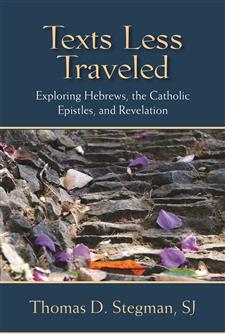 Texts Less Traveled: Exploring Hebrews, the Catholic Epistles, and Revelation (Paulist Press, 2022) is the latest book by New Testament scholar Thomas D. Stegman, S.J., dean and professor of the BC School of Theology and Ministry. Fr. Stegman highlights some key, yet lesser known, New Testament passages, such as Letter to the Hebrews; James; 1 and 2 Peter; 1, 2, and 3 John; Jude; and Revelation. Unlike the Gospels and letters of Paul, these texts—the final nine writings in the New Testament—are rarely the subject of preaching in the Church’s Sunday Eucharistic liturgy. Fr. Stegman’s other publications include Written for Our Instruction: Theological and Spiritual Riches in Romans; Opening the Door of Faith: Encountering Jesus and His Call to Discipleship; and Paulist Biblical Commentary.
Redressing a legacy of abuse in Ireland
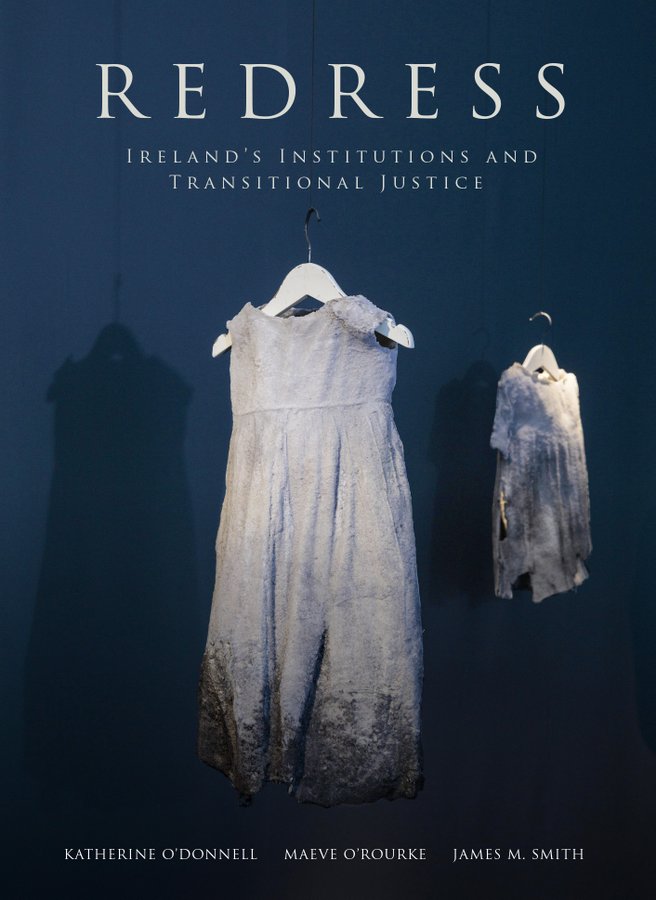 A new collection of interdisciplinary essays seeks to answer the question of how will Ireland remedy its legacy of institutional abuse. REDRESS: Ireland’s Institutions and Transitional Justice (University of College Dublin Press, 2022) focuses on the structures which perpetuated widespread and systematic abuses in the past and considers how political arrangements continue to exert power over survivors, adopted people and generations of relatives, as well as control the remains and memorialization of the dead. REDRESS explores what it might look like if survivors’ experiences and expertise were allowed to lead the response to a century of gender- and family separation-based abuses resulting from Magdalene Laundries, Mother and Baby Homes, County Homes, industrial and reformatory schools, and a closed and secretive adoption system. REDRESS is edited by Katherine O’Donnell (UCD School of Philosophy), Maeve O’Rourke (Irish Centre for Human Rights, School of Law, NUI Galway), and James Smith, an associate professor of English and Irish Studies at Boston College. Smith’s other publications include Ireland and the Magdalene Laundries: A Campaign for Justice; Ireland’s Magdalen Laundries and the Nation’s Architecture of Containment; and Children, Childhood and Irish Society: 1500 to the present. Read more about the book in this essay from National Catholic Reporter.
Posted in Boston College Authors
Tagged abuse, English Department, Ireland, Irish Studies, justice, transitional justice, trauma
Leave a comment
Understanding creativity and innovation
 While some organizational decision makers focus their attention on capital and physical resources, a new book reveals that effective people management should take center stage in the innovation process. The Handbook of Research on Creativity and Innovation (Edward Elgar Publishing, 2021) co-edited by Jing Zhou, professor of management and psychology at Rice University’s Jones Graduate School of Business, and Elizabeth (Bess) Rouse, associate professor at Boston College’s Carroll School of Management, showcases some of the most advanced and interesting work in the creativity and innovation field. The handbook also analyzes the role of social influences/team culture in the processes of creativity and innovation, as well as how to make sense of and study creativity and innovation. Rouse and O’Connor Family Professor Michael Pratt of the Carroll School co-wrote a chapter for the volume. The editors hope the handbook offers a platform for idea exchange and stimulates future research.
Reading Anselm
 New Readings of Anselm of Canterbury’s Intellectual Methods (Brill, 2022) presents essays that offer new readings of Anselm’s speculative and spiritual writings on topics including his relationship to Augustine, proofs for God’s existence, faith and reason, human freedom and the problem of evil, his spiritual meditations and prayers, as well as Anselm’s reception by 19th- and 20th-century thinkers, modernism, and feminism. These philosophical, theological, and literary analyses bring fresh perspectives on Anselm both in his historical context and in dialogue with contemporary questions. The papers in this volume were originally presented at the Boston College conference “Reading Anselm: Context and Criticism.” The volume is co-edited by John T. Slotemaker of Fairfield University and Eileen C. Sweeney, a professor of philosophy at Boston College. Sweeney also wrote an essay for the volume titled, “Anselm on Evil and Eudaimonism.” She is the author of Anselm of Canterbury and the Desire for the Word and Words in the Absence of Things: Logic, Theology and Poetry in Boethius Abelard and Alan of Lille.
 BC Bookmarks