
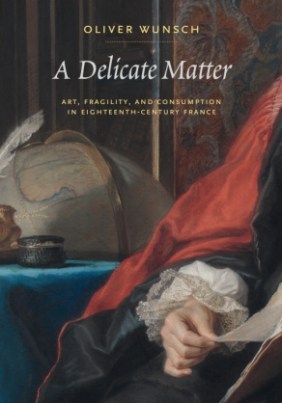
 Eighteenth-century France witnessed a proliferation of materially unstable art, from oil paintings that cracked within years of their creation to pastel portraits vulnerable to the slightest touch or vibration. A Delicate Matter: Art, Fragility, and Consumption in Eighteenth-Century France (Penn State University Press, 2024), written by BC Assistant Professor of Art History Oliver Wunsch, links these artistic practices to the economic and social conditions that enabled them, revealing how the rise of consumer culture fundamentally transformed the relationship between art, time, and value. Drawing on sources ranging from eighteenth-century artists’ writings to twenty-first-century laboratory analyses, A Delicate Matter challenges the art historical tendency to see decay as little more than an impediment to research, instead showing how physical instability played a critical role in establishing art’s meaning and purpose. Wunsch has a background as a painter and printmaker, and much of his research looks at the history of artistic techniques, with a focus on European and American art in the eighteenth and nineteenth centuries. He spoke about his book in this video from BC Libraries.
Art and fragility in eighteenth-century France
The Troubles, grief, and trauma
 Martin Doyle will discuss his new book, Dirty Linen: The Troubles In My Home Place (Merrion Press, 2023), at Boston College on April 3 at 5 p.m. in Connolly House. Dirty Linen is an intimate, personal history of the Northern Ireland conflict told through the testimony of the friends and families of more than 20 victims who died violently in the author’s own rural parish in County Down. The book was shortlisted for a 2023 An Post Book Award for Best Non-Fiction Book. Doyle is Books Editor of The Irish Times. He wrote an essay for the Irish Times about writing Dirty Linen. Doyle’s appearance is sponsored by the Boston College Irish Studies Program.
Posted in Guest Authors
Tagged nonfiction, Northern Ireland, The Troubles, trauma, violence
Leave a comment
Christ, Caesar, and the Gospel
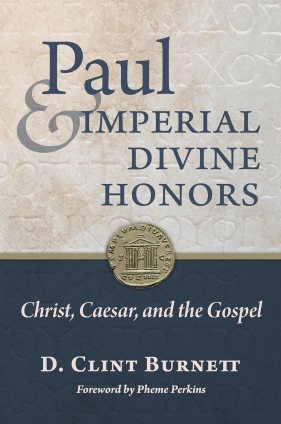 “Jesus is lord, not Caesar.” Many scholars and preachers attribute mistreatment of early Christians by Roman authorities to this fundamental confessional conflict, according to D. Clint Burnett, author of examines copious evidence—literary, epigraphic, numismatic, and archaeological—to more accurately reconstruct Christian engagement with imperial divine honors, with a focus on the cities of Philippi, Thessalonica, and Corinth. Burnett argues that early Christianity was not specifically anti-government but more broadly countercultural, and that responses to this stance ranged from conflict to apathy. His compelling argument challenges common assumptions about the first Christians’ place in the Roman Empire. Burnett earned a Ph.D. in biblical studies from Boston College. The book’s foreword was written by BC’s Joseph Professor of Catholic Spirituality Pheme Perkins.
The Shepherd’s Book of Visions
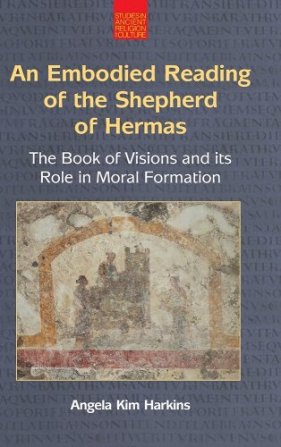 The Shepherd of Hermas (70–150 CE) is one of the oldest Christian writings and was enormously popular during the early centuries as a catechetical text used for moral formation. In her new book, Boston College Clough School of Theology and Ministry Professor of New Testament Angela Kim Harkins looks at the first section of the Shepherd known as the Book of Visions. In the An Embodied Reading of the Shepherd of Hermas: The Book of Visions and its Role in Moral Formation (Equinox Publishing, 2023), Harkins argues that enactive reading can help to generate immersive experiences of Hermas’s visions and explain the success of the Book of Visions among ancient readers. Cognitive approaches also highlight how modern scholars, who are trained to read apocalypses “against the grain” in their search for historical or theological information, fail to notice and appreciate the very things that made apocalypses engaging to a broad range of ancient readers and hearers.
Posted in Boston College Authors
Tagged biblical studies, School of Theology & Ministry
Leave a comment
Accolades for ‘Kantika’
 Professor of English Elizabeth Graver’s critically acclaimed novel, Kantika, is winner of a National Jewish Book Award in the category of Sephardic Culture. Kantika was inspired by Graver’s grandmother, who was born into a Sephardic Jewish family in Istanbul and whose life journey took her to Spain, Cuba, and New York. The novel was also named a best book of the year by National Public Radio, Lilith Magazine, and Libby. The New York Times listed it as one of the 10 Best Historical Fiction novels and 100 Notable Books of 2023. Next month, Graver will receive the Edward Lewis Wallant Award, presented to a writer whose published work of fiction is deemed to have significance to American Jewish history and culture. Read more in BC News.
Posted in Awards/Honors, Boston College Authors
Tagged English Department, historical fiction, Jewish history, novel, novelist
Leave a comment
Native kinship, institutionalization, and remembering
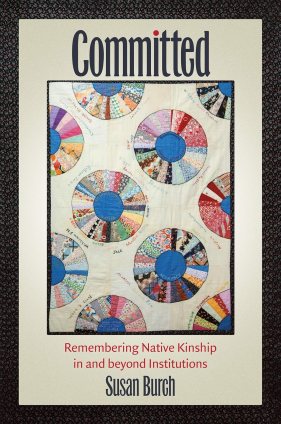 On March 21, historian Susan Burch, a professor of American studies at Middlebury College, will give a lecture connected to her most recent book, Committed: Remembering Native Kinship in and beyond Institutions (University of North Carolina Press, 2021). A co-founder of the Disability History Association, Burch’s research and teaching interests focus on the overlaps of deaf, disability, race, Indigeneity, and gender and sexuality in late nineteenth- and twentieth-century U.S. history. Committed, Burch’s award-winning book, centers on the lived experiences of Indigenous people at the Canton Asylum, a federal psychiatric facility in South Dakota and one of many places of imposed removal and confinement of Native Americans. Drawing on oral histories, correspondence, material objects, and archival sources, Burch tells the story of the people institutionalized and those who experienced the impact of this history. Burch’s lecture is presented by Boston College’s Park Street Corporation Speaker Series and will take place in Gasson 100 beginning at 7 p.m.
Posted in Guest Authors, Park Street Corporation Speaker Series
Tagged Native American, U.S history
Leave a comment
Everyday objects in colonial Ireland
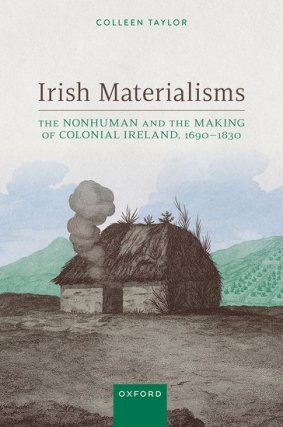 Irish Materialisms: The Nonhuman and the Making of Colonial Ireland, 1690-1830 (Oxford University Press, 2024), written by BC Assistant Professor of English and Irish Studies Colleen Taylor, is the first book to apply new materialist theory to the critical study of Ireland. Irish Materialisms provides original case studies on everyday objects in colonial Ireland (coins, flax, spinning wheels, mud, and pigs) to examine how each object’s unique materiality contributed to the colonial ideology of British paternalism and afforded creative Irish expression. Through an intimate understanding of the materiality Irish peasants handled on a daily basis, Taylor’s book presents a new portrait of Irish character that reflects greater empowerment, resistance, and expression in the oppressed Irish than has been previously recognized. Taylor specializes in eighteenth-century Irish and British literature and the environmental humanities.
Benedict Arnold
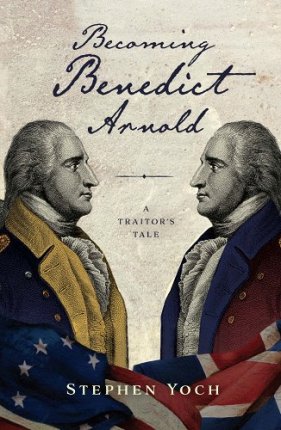 Benedict Arnold was a brilliant battlefield commander who betrayed America in its darkest hour. Becoming Benedict Arnold: A Traitor’s Tale is a new book by Boston College graduate Stephen Yoch that tells how avarice, political intrigue, and love transformed a wounded war hero into America’s most infamous traitor. Becoming Benedict Arnold includes detailed author’s notes providing sources and commentary on events so readers can come to know and understand the real story of Arnold. A lawyer and history buff, Yoch also is the author of Becoming George Washington. Yoch discussed Becoming Benedict Arnold in an interview with his local CBS affiliate.
Prepare to win
 Preparation is as powerful as it is simple. Yet, the rather elementary concept is difficult for many people to execute properly. Nick Cidado is an assistant strength & conditioning coach at Boston College and has worked with thousands of athletes over the course of his career. In his new book Sweat More During Peace, Bleed Less During War: Preparation Tactics that Generate Success, Cidado explains the way to think about preparation and shares the tools and techniques needed to prepare for success. He offers practical strategies that illustrate how tiny actions taken far before the moment of fruition ultimately create the expected result. He believes, “You don’t rise to the level of your desired performance, you fall to the degree in which you have prepared.”
Poet Paul Muldoon
 Pulitzer Prize winner Paul Muldoon will give a poetry reading on March 13 at 5:30 p.m. in Devlin Hall, room 101. An acclaimed poet, Muldoon was born in Portadown, County Armagh, in Northern Ireland, and is the author of numerous collections of poetry, including Howdie-Skelp, Frolic and Detour, One Thousand Things Worth Knowing, Hay, Why Brownlee Left, and New Weather. His poetry has been translated into 20 languages. His poetry collection Moy Sand and Gravel won the Pulitzer Prize for Poetry and Canada’s Griffin Poetry Prize. He has also published works of criticism, opera libretti, books for children, song lyrics, and radio and television drama. He currently holds the Howard G.B. Clark ’21 chair in the Humanities at Princeton University. Among his other awards are the 1994 T. S. Eliot Prize, the 1997 Irish Times Poetry Prize, the 2004 American Ireland Fund Literary Award, the 2004 Shakespeare Prize, and the 2017 Queen’s Gold Medal for Poetry. Sponsor: BC Irish Studies Program.
 BC Bookmarks