

The globalization of English
 Author and historian David Northrup, who taught in the History Department at Boston College for some 40 years, has published a new book that looks at the rise and global spread of the English language. Publisher Palgrave Macmillan calls How English Became the Global Language (2013) “the first [book] written about the globalization of the English language by a professional historian.” In a Q&A with Muscat Daily, Northrup discusses how the collapse of the Soviet Union and the spread of higher education were factors in the globalization of the English language.

Stories of conversion
 Boston College alumna and Boston College parent Patricia Sodano Ireland, who returned to the Catholic Church after serving as a Lutheran minister for 10 years, presents stories of women’s conversion to Catholicism in the book Women in Search of Truth: Converts to Catholicism Tell Their Stories, co-authored with Jennifer Ferrara. Ireland is a director of theology programs at St. Joseph’s College of Maine.

Looking at a generation of Asian-American writers
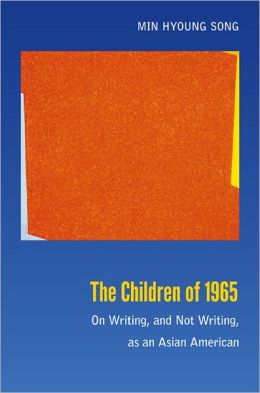
 In his new book, The Children of 1965: On Writing, and Not Writing, as an Asian American (Duke University Press Books, 2013), Boston College Associate Professor of English Min Hyoung Song focuses on the works by emerging Asian American authors such as graphic novelists Adrian Tomine and Gene Luen Yang, short story writer Nam Le and poet Cathy Park Hong, among others. Based on an analysis of more than 100 works and his interviews with several of these writers, Song argues that collectively, these works push against existing ways of thinking about race, even as they demonstrate how race can facilitate creativity. While some of the writers eschew their identification as ethnic writers, others embrace it, and in their literature, a number of them address pressing contemporary matters: demographic change, environmental catastrophe, and the widespread sense that the United States is in national decline. The title of Song’s book is a reference to the Immigration and Nationality Act of 1965 which lifted long-standing restrictions on immigration and ushered in the arrival of Asians to the US. Many of the authors in Song’s cohort of Asian American writers are children of these immigrants.
Posted in Boston College Authors
Tagged Asian American writers, English Department, immigration
Leave a comment
The instrinsic value of the arts
 Professor of Psychology Ellen Winner has co-authored a new book that looks at the impact of arts education and its connection to fostering skills for innovation. In Art for Art’s Sake? The Impact of Arts Education, Winner and co-authors Thalia R. Goldstein and Stéphan Vincent-Lancrin look at previous studies and research databases and considered art education that encompasses in school art classes as well as art study undertaken outside the classroom. The book was commissioned by the Organisation for Economic Cooperation and Development. The authors write that the primary justification of arts education is the intrinsic value of the arts, the mastery of craft and technique, and the acquisition of artistic habits of mind, such as close observation, envisioning, exploration, persistence, expression, collaboration, and reflection. Arts education should not be justified in terms of the collateral benefit it may have in other academic subjects.
Summer on the Cape
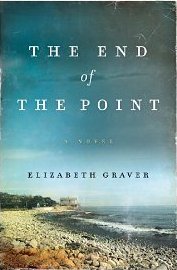
 Novelist Elizabeth Graver, a professor of English at Boston College, will talk about her new book, The End of The Point, at the Falmouth Public Library on June 25 at 7 p.m. The End of the Point is set in a summer community on Buzzards Bay between 1942-1999. Graver knows the Cape well and was among those asked to contribute to this month’s Boston Magazine piece titled “Summer on the Cape.” Not going to be in Falmouth on Tuesday? Follow Graver on Twitter
 @ElizabethGrave2 or check out ElizabethGraver.com to learn about future book readings.
International teachers in American schools
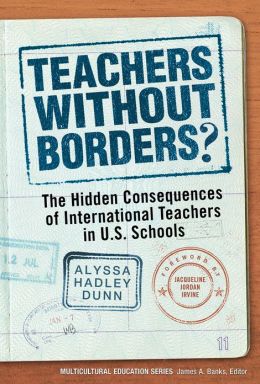
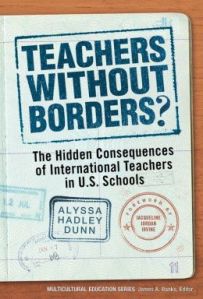 In her new book, Teachers Without Borders?: The Hidden Consequences of International Teachers in U.S. Schools (Teachers College Press), Boston College alumna Alyssa Hadley Dunn presents a case study of four teachers from India who came to the US to teach in urban schools. Their experiences are brought to life through interviews with their principals, district representatives and union representatives, as well as in-depth classroom observations and student commentary. Dunn’s work raises the question: If international teachers face daily exploitation, a lack of personal and professional support, and a lack of pedagogical and cultural preparation, are they able to give urban students the high-quality multicultural education they need and deserve? Dunn is an assistant professor in the Department of Middle-Secondary Education and Instructional Technology at Georgia State University College of Education.
Posted in Alumni Authors
Tagged education, international, muticultural education, urban schools
Leave a comment
“Blessed are the pure in heart”
 Boston College alumna Patricia Sodano Ireland, director of theology programs in the division of Graduate and Professional Studies at Saint Joseph’s College in Maine, is the author of the book, Guardian of a Pure Heart: St. Augustine on the Path to Heaven (Alba House). According to the publisher: This work examines the specific nature of the relationship between the requirement for seeing God (purity of heart) and the ultimate reward (the Beatific Vision), demonstrating that St. Augustine’s understanding of who Christ is for each of us requires a change of heart on our part that is true, habitual, lasting and sanctifying.

The gangs of Guatemala
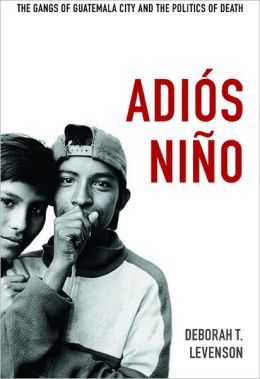
 Associate Professor of History Deborah T. Levenson writes about how war and politics helped shape the gangs of Guatemala in her new book, Adiós Niño: The Gangs of Guatemala City and the Politics of Death. A historical study, Adiós Niño examines transformations in the Guatemalan gangs, called Maras, from their emergence in the 1980s to the early 2000s. According to the publisher: Levenson describes how fragile spaces of friendship and exploration turned into rigid and violent ones in which youth, and especially young men, came to employ death as a natural way of living for the short period that they expected to survive. Part of Guatemala City’s reconfigured social, political, and cultural milieu, with their members often trapped in Guatemala’s growing prison system, the gangs are used to justify remilitarization in Guatemala’s contemporary postwar, post-peace era. Portraying the Maras as microcosms of broader tragedies, and pointing out the difficulties faced by those youth who seek to escape the gangs, Levenson poses important questions about the relationship between trauma, memory, and historical agency.
Posted in Boston College Authors
Tagged Guatemala, History Department, Latin America, violence
Leave a comment

 BC Bookmarks