
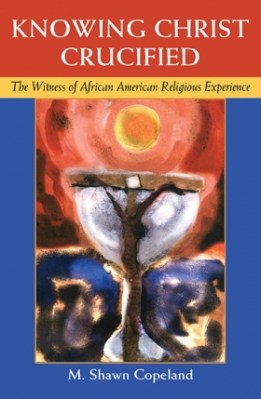
 Knowing Christ Crucified: The Witness of African American Religious Experience (Orbis Books, 2018), a new book by Professor of Theology M. Shawn Copeland, “is a powerful reading of the Cross of Jesus, both as it is written in scripture and in the experience of the poor and oppressed—particularly in the history of black people in America, from the time of slavery up to the present,” according to the publisher. Copeland writes that discipleship calls the faithful to “act in solidarity with all those who suffer social oppression and to join them in the struggle for life and justice.” An award-winning theologian, Copeland also is the author of Enfleshing Freedom: Body, Race, and Being.
The witness of African American religious experience
Posted in Boston College Authors
Tagged African American history, Catholicism, Theology Department
1 Comment
The Privately Printed Bible
 The Privately Printed Bible: Private & Fine Press Editions of Biblical Texts in the British Isles and North America, 1892-2000 (Oak Knoll Press) by Boston College alumnus Ronald D. Patkus is the first book to offer a broad survey of the history of private and fine press printings of biblical texts. Patkus focuses on English-language examples from the United Kingdom, Ireland, and North America, and includes more than 500 works in his study and more than 100 illustrations that demonstrate the aesthetics of layout, design, and illustration taken up by various presses. The book is divided into chapters that each deal with a specific generation of printers: the Revival, the “Second Generation,” the Postwar Era, and the late 20th century. In his book, Patkus describes key texts, such as the Doves Bible, the Oxford Lectern Bible, the Golden Cockerel Four Gospels, the Spiral Press Ecclesiastes, the Pennyroyal Caxton Bible, and the Arion Press Bible. Patkus received a BA and PhD from from Boston College. He holds the Frederick Weyerhaeuser Endowed Chair in Biblical Literature and Bibliography at Vassar College where he serves as associate director of the libraries for special collections and is a member of the History Department. He previously was head of archives at the John J. Burns Library at Boston College. His volume was reviewed recently by Burns Library Conservator Barbara Adams Hebard for the Guild of Book Workers Newsletter.
Workplace blues
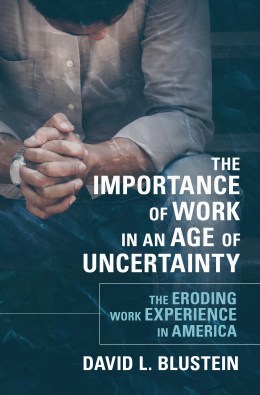 The American workplace has eroded across many dimensions, leaving workers feeling untethered and insecure about their futures, according to a new book by Lynch School of Education and Human Development Professor of Counseling Psychology David Blustein, one of the nation’s foremost experts on the psychology of work. The Importance of Work in an Age of Uncertainty: The Eroding Work Experience in America (Oxford University Press, June 2019) details Blustein’s new research that finds American workers increasingly beset by anxiety and distress wrought by economic trends that have reshaped when, where, how, and how long Americans work to earn both a living and a sense of purpose. Blustein hopes his findings will add a needed psychological perspective to debates and policies about work that thus far have been mainly limited to economic and political considerations. Read more from Boston College Chronicle.
The old neighborhood
 In his new book, Professor of English Carlo Rotella mixes journalism and memoir to write about his hometown, Chicago, and about the greater question of what defines a neighborhood. Rotella interviewed current and former residents of the neighborhood where he grew up, Chicago’s South Shore. As detailed in The World Is Always Coming to an End: Pulling Together and Apart in a Chicago Neighborhood (University of Chicago Press, May 2019) South Shore is a study in contrasts, shaped over the past 50 years by issues of race, class, crime, and other influences. As the middle class disappeared, South Shore became a place of the haves and have-nots, making it difficult for residents to recognize each other as neighbors. A microcosm for the American urban neighborhood, Chicago’s South Shore challenges one to think about how neighbors can build bridges and take down walls in order to create a vibrant community.Rotella, who teaches in BC’s American Studies program, is also the author of Cut Time: An Education at the Fights and Good With Their Hands: Boxers, Bluesmen, and Other Characters from the Rust Belt, among other titles. Read an interview with Rotella in the Chicago Tribune.
Posted in Boston College Authors
Tagged Chicago, city life, English Department, urban life
Leave a comment
Blessed are the Peacemakers
 In her new book Blessed Are the Peacemakers: Pacifism, Just War, and Peacebuilding (Fortress Press, 2019), Monan Professor of Theology Lisa Sowle Cahill offers a historical understanding of pacifism and just war theory, while advocating a newer approach to conflict situations called peacebuilding. According to Cahill, peacebuilding seeks to transform conditions of violence and bring about a just and sustainable peace. It is particularly needed in the 21st century as evidence grows that other approaches have failed to achieve sustainable peace. She writes: “Peacebuilders agree on the preeminent importance of taking non-violent yet forceful measures to deter ongoing violence, undo social injustice, and bring opposed groups together around a negotiated vision of social coexistence and cooperation.”
When is free trade not free?
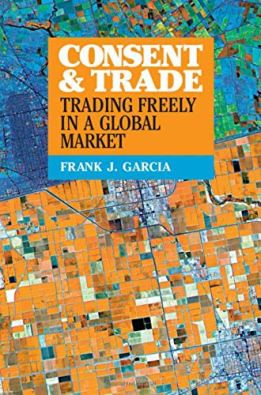 In his new book Consent and Trade: Trading Freely in a Global Market (Cambridge University Press, 2019), BC Law School Professor Frank Garcia offers an examination of trade law’s roots in consensual exchange, highlighting the central role of consent in differentiating trade from legally facilitated coercion, exploitation or predation. Garcia contends the U.S. needs to re-capture a vision of trade as mutually beneficial consensual exchange, and negotiate agreements that protect and enhance consent, rather than undermine it. By recovering the idea of consent in trade law, in a global marketplace, the U.S. and its trade partners can flourish. Recently, BC’s Clough Center for the Study of Constitutional Democracy gathered a group of international scholars for a roundtable discussion of the ideas put forth by Garcia in his book. Read more in Boston College Law School Magazine.
Posted in Boston College Authors
Tagged Boston College Law School, international trade
Leave a comment
Award for Young
 Dr. C. Dale Young, a Boston College alumnus from the Class of 1991, will receive the 2019 Distinguished Alumni Arts Award from the BC Arts Council on Apr. 26. The award recognizes graduates who have demonstrated creativity, innovation, leadership, and vision through their contributions to the arts. Young is the author of a novel in stories, The Affliction, and four collections of poetry, the most recent being The Halo. For more about the award ceremony and Young’s public discussion about his work with Professor of English Suzanne Matson, see the BC Arts Festival website.
Remembering Nabokov
 Professor of Russian, English, and Jewish Studies Maxim D. Shrayer marked the 120th anniversary of Vladimir Nabokov’s birth on April 22 with an essay on visiting the Nabokovs’ last home, in Montreaux, Switzerland. The essay appeared in the Los Angeles Review of Books. Shrayer’s publications include Waiting for America: A Story of Emigration, Yom Kippur in Amsterdam, Leaving Russia: A Jewish Story, among other titles.
The Power of Sports
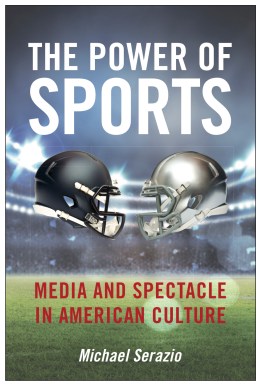 A former reporter, Associate Professor of Communication Michael Serazio turns his journalistic eye on sports in America in his new book, The Power of Sports: Media and Spectacle in American Culture (NYU Press, April 2019). After conducting more than 50 interviews with people in sports media as well as the business and marketing of sports, Serazio argues that the idea of sports as merely an entertaining diversion is a myth. Rather, he contends, sports has messaging on topics such as politics, gender, economic inequality, and other issues, and is a lens through which we can observe and understand American culture as it is today. Serazio also writes about the spiritual appeal of sports in a culture that is increasingly moving away from organized religion and, as one of the last remaining live television experiences, sports’ lucrative power in the field of advertising and branding. Serazio has written for The Washington Post and The Atlantic, among other outlets. His previous book is Your Ad Here: The Cool Sell of Guerrilla Marketing. Serazio recently discussed his book on WNPV-AM.
Mayan women
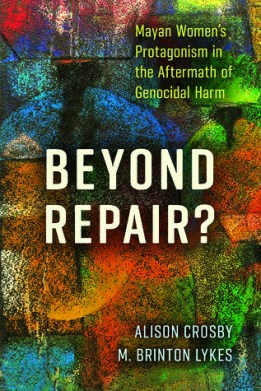 The Center for Human Rights and International Justice will host an event Apr. 25 to mark the publication of a new book co-authored by BC Lynch School of Education and Human Development Professor M. Brinton Lykes and Alison Crosby of York University in Toronto. At the event, the co-authors will discuss their book, Beyond Repair? Mayan Women’s Protagonism in the Aftermath of Genocidal Harm (Rutgers University Press, May 2019), followed by responses from scholars. According to the publisher, Beyond Repair “explores Mayan women’s agency in the search for redress for harm suffered during the genocidal violence perpetrated by the Guatemalan state in the early 1980s at the height of the 36-year armed conflict. The book draws on research conducted with 54 Q’eqchi’, Kaqchikel, Chuj, and Mam women who are seeking truth, justice, and reparation for the violence they experienced during the war, and the women’s rights activists, lawyers, psychologists, Mayan rights activists, and researchers who have accompanied them as intermediaries for more than a decade.” The book talk, which will be moderated by BC Law School Professor Katie Young, will begin at 4:30 p.m. in Campion Hall, room 139. Books will be available for sale at the event. Lykes is also the co-director of the Center for Human Rights and International Justice.
 BC Bookmarks