
Mercy
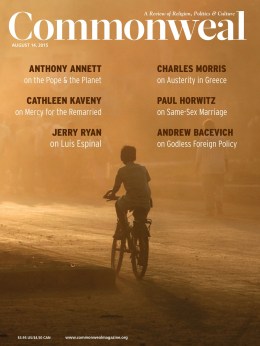 In the latest issue of Commonweal, Darald and Juliet Libby Professor of Law and Theology Cathleen Kaveny writes about what the Catholic Church can learn from civil law in her essay, “Mercy for the Remarried.”

Opening the Door of Faith
 Pope Francis’ encyclical on faith, Lumen Fidei, speaks of the relational aspect of faith—that is, faith as a response to God’s love revealed through Jesus. In his new book, Opening the Door of Faith: Encountering Jesus and His Call to Discipleship (Paulist Press, 2015), Jesuit priest Thomas Stegman, an associate professor of the New Testament in the Boston College School of Theology and Ministry, brings forth for study and reflection on the issue of faith the five major voices of the New Testament: Matthew, Mark, Luke, John and Paul. More from BC News.

Posted in Boston College Authors
Tagged Catholicism, faith, Jesuit author, School of Theology and Ministry
Leave a comment
Becoming a R.E.A.L. man
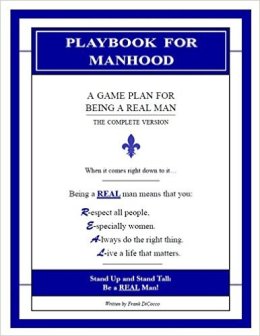 Boston College alumnus Frank DiCocco, a football coach at the high school and college level, created a character curriculum called the R.E.A.L. (R-espect all people, E-specially women, A-lways do the right thing, L-ive a life that matters) Man Program to help the young men that he was coaching lead more successful lives. The program, which has been endorsed by the director of the American Football Coaches Association and the director of the Texas High School Coaches Association, is being taught in middle schools, high schools and colleges nationwide. DiCocco wrote books for the program, including Playbook for Manhood: A Game Plan for Being a Real Man. He also authored books about hope and life lessons, including Advice for Life: Insights for Living and Always Hope: A Collection of Insights, Prayers & Blessings. He founded the non-profit H.O.P.E. Foundation for a Better Tomorrow to provide character development programs and scholarships. DiCocco passed away in 2013 at age 29. His parents have taken up the work of the foundation, spreading awareness of the R.E.A.L. man character program to coaches and educators around the country and bestowing more than a dozen “Coach Frank D.B. DiCocco Memorial Scholarships” to students from Connecticut to Hawaii. To learn more, visit www.HOPEFoundation.us.

Lebanese nationalist Charles Corm
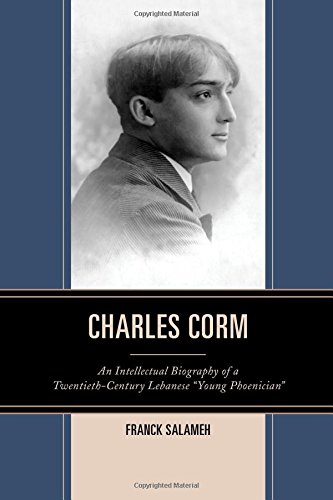
 In the new book, Charles Corm: An Intellectual Biography of a Twentieth-Century Lebanese “Young Phoenician” (Lexington Books, 2015), Associate Professor of Near Eastern Studies Franck Salameh writes about Lebanese writer and businessman Charles Corm, an influential figure in the nationalism movement that led to Lebanon’s independence. Salameh delves into the history of the modern Middle East and into Lebanese intellectual, cultural and political life as incarnated in the ideas, and as illustrated by the times, works and activities of Corm (1894–1963). A leading figure in the “Young Phoenicians” movement, Corm became “the conscience” of Lebanese society at a crucial juncture in its modern history, according to Salameh.
Posted in Boston College Authors
Tagged Lebanon, Middle East, Slavic and Eastern Languages Dept
4 Comments
Barrio Rising
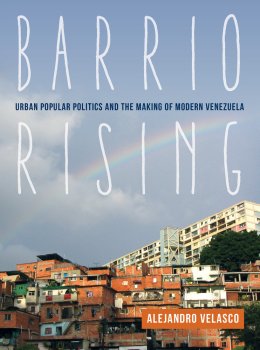 In the mid-1950s, Venezuela’s military government razed a massive slum settlement in the heart of Carácas and replaced it with what was at the time one of Latin America’s largest public housing projects. When the dictator Marcos Pérez Jiménez was overthrown on January 23, 1958, thousands of people rushed to occupy the uninhabited portions of the project, taking it over and renaming the resulting neighborhood for the date of the fall of the regime: the 23 de Enero. The neighborhood that emerged stood at the geographic and in some cases political center of Venezuela’s transition to democracy over the decades that followed. This unruly, often contradictory transition is detailed in a new book, Barrio Rising: Popular Politics and the Making of Modern Venezuela (University of California Press, 2015) by Boston College alumnus Alejandro Velasco. The book traces how the residents of the 23 de Enero came to fashion an expansive understanding of democracy–both radical and electoral–from the late 1950s to the early 1990s, and examines how that understanding still resonates today. Velasco is on the faculty of New York University.

Do Guns Make Us Free?
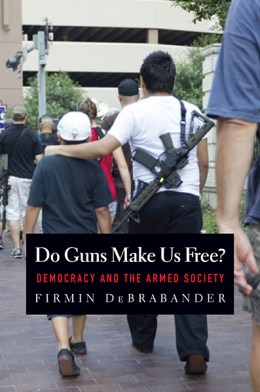 One of the most emotionally charged debates in the United States centers on the Second Amendment and the rights of citizens to bear arms. In his new book, Do Guns Make Us Free?: Democracy and the Armed Society (Yale University Press, 2015), Boston College alumnus Firmin DeBrabander examines the contentious and uniquely American debate over guns and contends an armed society is not a free society but one that actively hinders democratic participation. DeBrabander is an associate professor of philosophy at Maryland Institute College of Art and has written pieces for the Baltimore Sun, Common Dreams, Counterpunch, and the New York Times.
Posted in Alumni Authors
Tagged America, constitution, gun control, Philosophy Department
Leave a comment

 BC Bookmarks