
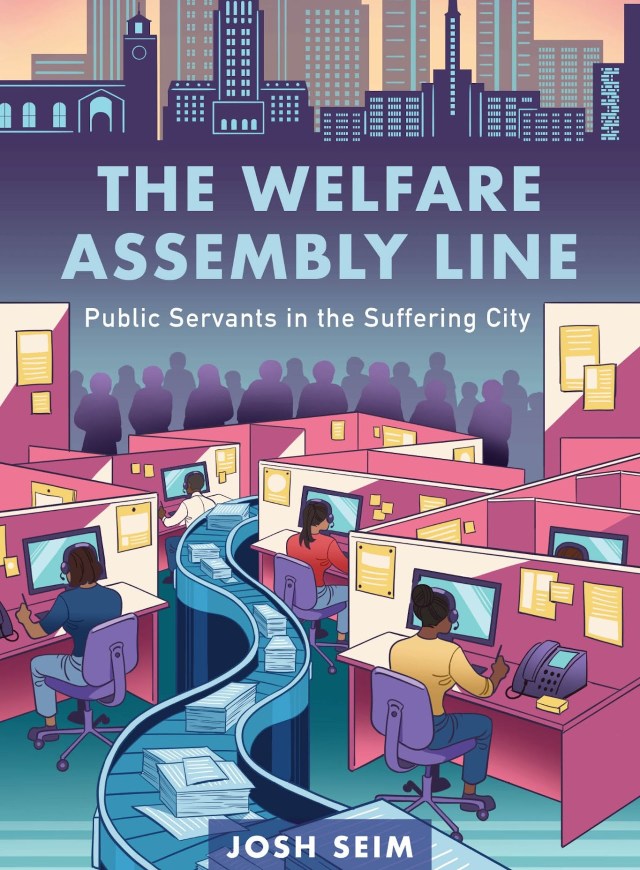
 Despite claims that we live in a “post-welfare society,” welfare offices remain vital not only for those who depend on them for benefits but also for those who depend on them for a paycheck. The Welfare Assembly Line: Public Servants in the Suffering City (University of California Press, 2026) by Boston College sociologist Josh Seim is a theory-driven case study of the Los Angeles County Department of Public Social Services that examines how welfare work has transformed to allow a department of just 14,000 to serve more than a third of the county. In The Welfare Assembly Line, Seim argues that frontline workers at this agency—who are mostly Black and Brown women—have become increasingly proletarianized. His study reveals a high division of labor and heavy use of machinery resembling production regimes in factories and fast-food restaurants. The result are workers with less discretion and a lack of control over the productive process. Seim’s research, which focuses on issues related to work, medicine, welfare, and punishment, has appeared in American Sociological Review, Sociological Methods and Research, Social Science and Medicine, Sociology of Health and Illness, Punishment and Society, and many other outlets. He also is author of Bandage, Sort, and Hustle: Ambulance Crews on the Front Lines of Urban Suffering.
Policy factory
This entry was posted in Boston College Authors and tagged Sociology Department, work. Bookmark the permalink.
 BC Bookmarks