
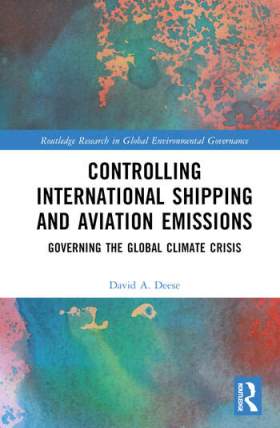
 International shipping and aviation stand as two major sources of global greenhouse gas emissions not governed by national inventories and the U.N. Paris Climate agreement. Since the Kyoto Protocol in 1997, regulating greenhouse gas emissions from these two industries has been assigned to the International Maritime Organization in London and the International Civil Aviation Organization in Montreal. Yet, they have not met their mandates in the face of global pressure to act, concludes Boston College Political Science Professor and climate policy expert David Deese in his new book Controlling International Shipping and Aviation Emissions: Governing the Global Climate Crisis (Routledge, 2023). Deese’s book reveals why these two U.N. agencies have largely failed in their efforts and highlights the most promising emerging and feasible technologies to control and reduce greenhouse gas emissions in the ships that ply the seas and aircraft that travel the skies. Read more on BC News.
In the air and on the sea, pollution goes under the radar
This entry was posted in Boston College Authors and tagged climate change, policymakers, Political Science department, pollution. Bookmark the permalink.
 BC Bookmarks